Friday, March 05, 2004
A few weeks ago we had two artists in our group talk about the connection between art and our view of heaven and hell. In light of the buzz about Mel's movie, The Passion, I thought it might be equally stimulating to see the connection between art and our evolving image of Jesus.
Take a tour of art history as it relates to images of Jesus at: http://www.beliefnet.com/story/22/story_2283_1.html.
Here are a couple examples:

This is The Epic of American Civilization: Modern Migration of the Spirit (Panel 21) by Jose Clemente Orozco, painted between the years 1932-34.
"For Orozco and other modern Third World artists, Jesus becomes the liberator, or, more narrowly, the icon of liberation. The oppressed have, from Jesus' own time on, clung to him in hope of release from injustice and from dominance by the ruling class. Images such as these become icons of hope."
--Stephen Cook
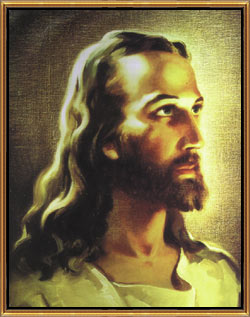
This is Head of Christ by Warner Sallman painted in 1940.
"Warner Sallman produced a modern popular image of Jesus that became one of the most-reproduced paintings of all time, showing up in countless church parlors and classrooms and on devotional materials. It became the dominant image of Christ in the 20th century and the one people most often recall when asked what Jesus looked like."
--Stephen Cook
When you are finished, you might want to bookmark this home site as a great resource! It's called New Testament Gateway: http://www.ntgateway.com/
Take a tour of art history as it relates to images of Jesus at: http://www.beliefnet.com/story/22/story_2283_1.html.
Here are a couple examples:
This is The Epic of American Civilization: Modern Migration of the Spirit (Panel 21) by Jose Clemente Orozco, painted between the years 1932-34.
"For Orozco and other modern Third World artists, Jesus becomes the liberator, or, more narrowly, the icon of liberation. The oppressed have, from Jesus' own time on, clung to him in hope of release from injustice and from dominance by the ruling class. Images such as these become icons of hope."
--Stephen Cook
This is Head of Christ by Warner Sallman painted in 1940.
"Warner Sallman produced a modern popular image of Jesus that became one of the most-reproduced paintings of all time, showing up in countless church parlors and classrooms and on devotional materials. It became the dominant image of Christ in the 20th century and the one people most often recall when asked what Jesus looked like."
--Stephen Cook
When you are finished, you might want to bookmark this home site as a great resource! It's called New Testament Gateway: http://www.ntgateway.com/
Thursday, March 04, 2004
The church is the bearer to all the nations of a gospel that announces the kingdom, the reign, and the sovereignty of God. It calls men and women to repent of their false loyalty to other powers, to become believers in the one true sovereignty, and so to become corporately a sign, instrument, and foretaste of that sovereignty of the one true and living God over all nature, all nations, and all human lives. It is not meant to call men and women out of the world into a safe religious enclave but to call them out in order to send them back as agents of God's kingship.
- from Foolishness to the Greeks, Leslie Newbigin, p.124
- from Foolishness to the Greeks, Leslie Newbigin, p.124
Tuesday, March 02, 2004
When you begin to look for the centrality of the resurrection in Paul's writings, it is amazing what jumps out of the text! I was reading 2 Timothy this morning, Paul's final letter as he awaited execution in a Roman jail. Someone has said that awareness of one's impending death tends to focus the thoughts. Here Paul is writing with focus. He wants to pass on instructions to Timothy, his son in the faith. In the opening, Paul gives thanks and then tells Timothy to not be ashamed of either the gospel or of Paul's imprisonment for the gospel. This takes Paul into the storytelling mode (1:8-12). He tells "the story" (the gospel). But notice how he describes the impact of Jesus' appearing (1:10): "...the appearing of our Savior Christ Jesus, who abolished death and brought life and immortality to light through the gospel."
This is a picture of victory on a cosmic scale! This is much larger than a gospel that says, "Jesus came to die for our sins." To abolish death is to deal with the central problem of the human race. But he does not stop there. He says the gospel is about life and immortality. The gospel that focuses only on personal forgiveness is so small in comparison to the gospel Paul proclaims. His gospel is about life. The question he answers is, "How can you truly and fully live in the midst of a culture of death?" The question we often answer is, "How can you be forgiven of your sins?" (which means we have to convince relativists that there is an objective moral standard and that they have fallen short and will be judged by God). Paul's gospel was about the incredible good news of entering eternal life now and living out that life in all its fullness in the present. Again, this is not an act of visualization. It is the reality of living between the two great events of Jesus' death/resurrection and the final consummation when Jesus returns and establishes his kingdom on earth.
Are we pro-life in the fullest Pauline sense?
This is a picture of victory on a cosmic scale! This is much larger than a gospel that says, "Jesus came to die for our sins." To abolish death is to deal with the central problem of the human race. But he does not stop there. He says the gospel is about life and immortality. The gospel that focuses only on personal forgiveness is so small in comparison to the gospel Paul proclaims. His gospel is about life. The question he answers is, "How can you truly and fully live in the midst of a culture of death?" The question we often answer is, "How can you be forgiven of your sins?" (which means we have to convince relativists that there is an objective moral standard and that they have fallen short and will be judged by God). Paul's gospel was about the incredible good news of entering eternal life now and living out that life in all its fullness in the present. Again, this is not an act of visualization. It is the reality of living between the two great events of Jesus' death/resurrection and the final consummation when Jesus returns and establishes his kingdom on earth.
Are we pro-life in the fullest Pauline sense?
